Last checked:
Translated from German. In case of discrepancies, the German version applies.
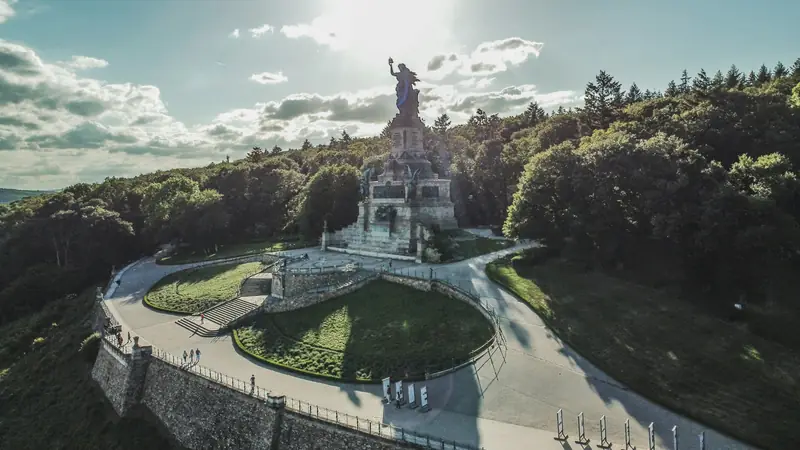
Niederwalddenkmal
The Niederwalddenkmal (Niederwald Monument) above Rüdesheim is more than 38 metres high and was built from 1877 to 1883. It commemorates the founding of the German Empire after the Franco-Prussian War of 1870/71.1 The monument and the park are open to all; no admission is charged.2
What the monument shows
At its centre stands the bronze Germania, a colossal female figure who embodies the Empire. The pedestal bears the inscription “Wiederaufrichtung des Deutschen Reiches” (“Re-establishment of the German Empire”).1
The main relief shows Wilhelm I; another relief is titled “Der Abschied” (“The Farewell”). The monument was designed by the sculptor Johannes Schilling (1828–1910) and the architect Karl Weißbach (1841–1905).1
The monument is a testimony of its time: it celebrates the unification of 25 individual states into one empire, after a war against France.1 Visitors therefore see not only a viewpoint but also a political monument of the 19th century. The Staatliche Schlösser und Gärten Hessen (Hessian state palaces and gardens administration) offer a free audio guide via a smartphone app.2
The Osteinscher Niederwald
Around the monument lies the Osteinscher Niederwald, a landscape park from the last third of the 18th century – older than the monument itself.3
In 1763 Count Karl Maximilian von Ostein inherited an estate of around 304 hectares and turned part of it into a park woodland; from 1764 it served as his summer residence. Scattered through the woods are park buildings such as the temple, the Rossel – one of the early artificial ruins in Germany – and the Zauberhöhle (magic cave).3 The woods and the monument are open to all.3
The Niederwaldtempel (temple) was destroyed in November 1944 and rededicated in June 2006 after reconstruction.4 The Zauberhöhle, laid out around 1790, is a passage about 60 metres long that ends in a rotunda with a view of the Rhine.5 Short portraits of all the park buildings: Well-known names and places.
Our assessment: if you take the cable car up, it is worth allowing one to two hours for the park.
The Jagdschloss Niederwald
In the middle of the Niederwald stands the Jagdschloss Niederwald, a former hunting lodge. Count Ostein had it built from 1764 to 1766 as a “manor house” to plans by the Mainz stonemason Anton Süß.6 The estate included a chapel, farm buildings for livestock, a house for the forester and an inn for the many visitors.6
The Niederwald then changed hands several times: in 1853 the Nassau state domain administration bought it, and in 1866 it passed to Prussia together with the Duchy of Nassau. The Jagdschloss remained the centre; foresters and later leaseholders served the guests there. In 1886 the leaseholder extended the house with a hall and guest rooms. After a fire in 1925 a hotel was built again, which was run from 1926 onwards.6 It did not remain a hotel throughout: according to the hotel, the house served as a military hospital during the Second World War and afterwards as a recreation centre for American officers.7
In July 1948 the minister-presidents of the West German states met here to discuss the Frankfurt Documents of the Western Allies – the so-called Niederwald-Konferenz (Niederwald Conference), a step on the way to the Grundgesetz, Germany’s Basic Law.7,
Today the Jagdschloss is a hotel (address: Jagdschloss Niederwald 1, 65385 Rüdesheim am Rhein).9 You will find it in our directory Where to stay.
How to get there
- Cable car from Rüdesheim’s old town, since 1954.10 Details, season and accessibility: Cable car and paths up the hill.
- On foot through the vineyards – the cable car operator even offers the combination “up by cable car, back on foot” for this. See Cable car and paths up the hill.
- By car: at the Niederwalddenkmal there is a car park open all year round, close to the monument, the temple and the mountain station of the cable car.4
A monument as a destination
Already for the inauguration in September 1883 Rüdesheim was full of visitors; the monument finally made the town a destination for excursions.11 The first visitors went up by rack railway, today they take the cabin cable car.12
More about the Niederwalddenkmal
Pictures, construction history and much more about the monument are collected by the project Niederwalddenkmal.de – Alles rund um das Niederwalddenkmal (in German).13
What else there is to do nearby: Day trips · Stopping for food up on the Niederwald: Food and drink · Staying overnight in the woods: Where to stay
Frequently asked questions
Is there an admission charge for the Niederwalddenkmal? No, the monument and the park are open to all.2
How high is the Niederwalddenkmal? More than 38 metres.1
Who created the monument? The sculptor Johannes Schilling and the architect Karl Weißbach.1
What is the Jagdschloss Niederwald?
A building by Count Ostein from 1764–1766 in the Niederwald, now a hotel. According to the hotel and Der Spiegel, the West German minister-presidents met there in July 1948 (Niederwald-Konferenz); the town archive gives 1949.6,